


Contents
- Yacht interiors: why material requirements are so crucial
- What requirements do yachts place on materials?
- Key materials for yacht interiors and their properties
- From idea to reality: how to plan material concepts for yachts effectively
- Why Schwanekamp Interior is ideally suited to demanding yacht interiors
Yacht interiors: why material requirements are so crucial
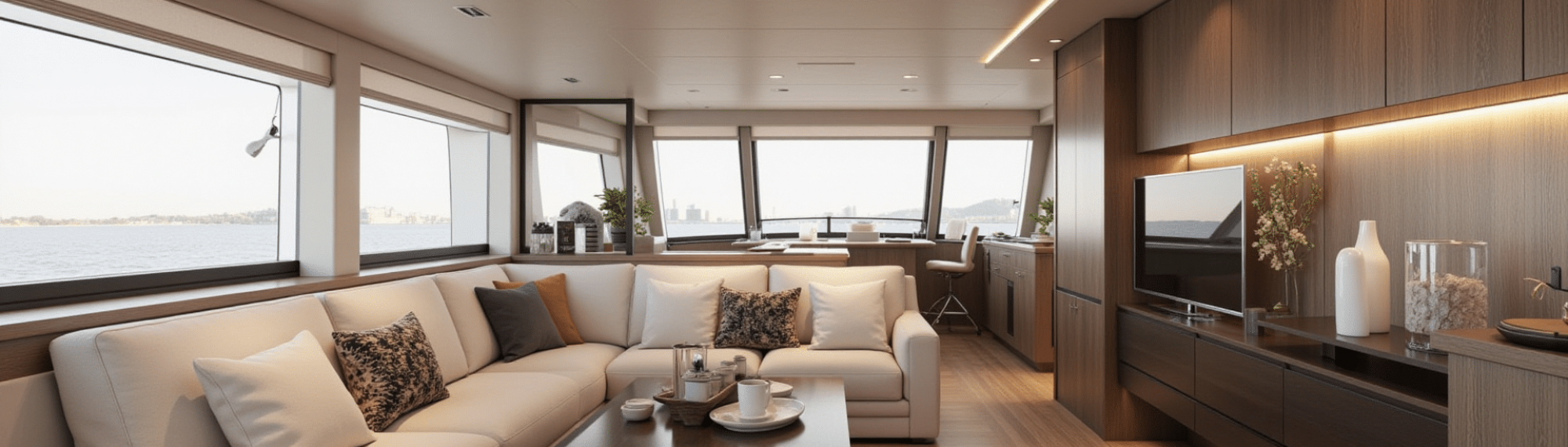
Yacht interiors combine luxurious living with extreme technical conditions. Salt-laden air, constant movement and limited space impose entirely different demands on materials than a house on land. This article provides a well-founded overview of the key material requirements, typical materials and planning principles for high-end yacht fit-outs.
What requirements do yachts place on materials?
Maritime environmental conditions as a starting point
On a yacht, several stresses act on every component at the same time. For professional material selection, these factors must always be considered together:
- Moisture and high humidity: materials must retain their shape, have low swelling behaviour and be protected against mould growth.
- Salt spray and UV radiation: surfaces require high corrosion and UV resistance.
- Temperature fluctuations: from a cool breeze to intense sunlight—coefficients of expansion and composite constructions must be designed accordingly.
- Constant movement and vibration: fittings, joints and fixings require special marine-grade solutions.
Weight, structure and safety
Every kilogram counts in a yacht interior. Materials must offer an optimum balance of weight, stability and workability. At the same time, international regulations and classifications must be taken into account:
- Fire performance: flame-retardant or certified materials (for example in line with IMO requirements) are mandatory in many areas.
- Slip resistance: non-slip surfaces are essential, particularly in transition areas and wet zones.
- Breakage safety: glass and ceramics must be specified as safety glass or as special laminated systems.
Luxury standards and durability
Yacht owners expect an interior quality that remains representative and high-value even after years of intensive use. This results in further requirements:
- high abrasion and scratch resistance for surfaces
- colour stability despite exposure to sunlight
- repairability and a spare-parts strategy for long-term use
Key materials for yacht interiors and their properties
Wood and wood-based materials
Despite high-tech materials, wood remains a central element of yacht interiors. The key is the right combination of substrate, face veneer and surface build-up:
- Core panels: lightweight, high-quality composite panels instead of conventional solid chipboard
- Veneers: fine timbers from responsibly managed forests for sustainable luxury
- Surfaces: multi-layer lacquer systems with high scratch and water resistance
Schwanekamp Interior has been working with wood since 1905, combining traditional veneer craftsmanship with modern CNC and 3D technology—an important factor in the precise implementation of demanding geometries in yacht interiors.
Metals and exclusive finishes
Metals bring elegance and technical robustness to yacht interiors. Typical materials include:
- Corrosion-resistant alloys: carefully selected stainless steels and non-ferrous metals
- Liquid-metal coatings: creating metallic surfaces on lightweight substrates—visually similar to solid metal, yet with significantly lower weight.
Exclusive surface finishes allow subtle accents to be introduced, in line with the trend of defining luxury through materials rather than opulent forms.
Solid-surface materials, ceramics and glass
These materials are essential for wet areas, kitchens and representative surfaces on yachts:
- Solid-surface materials: seamless, hygienic and thermoformable—ideal for washbasins, worktops and organic shapes.
- High-performance ceramics: extremely hard, heat and scratch resistant, and suitable for worktops in galley areas.
- Specialist glass: safety glass, satin-finished or switchable glass surfaces for variable transparency and privacy.
High-quality plastics and composite materials
To reduce weight while retaining stability, numerous composites are used in yacht construction:
- lightweight composite panels as substrates for veneers and decorative surfaces
- special plastics for heavily used edges, decorative profiles and technical components
With in-house 3D printing, Schwanekamp Interior can adapt bespoke components and decorative elements precisely to a yacht’s geometry—a real advantage for individual solutions.
From idea to reality: how to plan material concepts for yachts effectively
Interlinking function, aesthetics and technology
A coherent material concept for a yacht always begins with a clear functional analysis of the spaces: where will high mechanical stresses occur? Where is ease of cleaning the priority? Which zones are representative and which are primarily functional?
For yacht projects, Schwanekamp Interior works with 3D visualisations and optional virtual-reality presentations. This enables owners, architects and designers to assess how materials perform in daylight, artificial light and different scenarios—before the first component is manufactured.
Resolving typical material conflicts early
Yachts often involve conflicting requirements, for example:
- maximum gloss versus susceptibility to fingerprints
- a solid appearance versus a weight limit
- natural materials versus high moisture exposure
This is where Schwanekamp Interior’s material expertise pays off: through value engineering, design ideas are assessed for feasibility, structure, cost and durability—without losing the desired appearance.
Applying yacht-interior trends with purpose
Current developments in premium interior architecture also shape the yacht sector:
- Natural colours and materials: light fine timbers, refined stone and matt metal surfaces.
- Organic forms: flowing furniture contours, integrated lighting and reduced joint lines.
- Smart home on board: invisibly integrated technology that does not compromise the effect of surfaces and materials.
- Sustainability: responsible material sources, long-lasting constructions and repair-friendly assemblies.
Why Schwanekamp Interior is ideally suited to demanding yacht interiors
Based in Vreden-Lünten, Germany, Schwanekamp Interior has combined more than 115 years of German craftsmanship with modern interior-design technology. As part of the MOprojects Group, yacht projects benefit from international expertise and state-of-the-art production facilities—from concept development and 3D visualisation through to installation on board.
Every project receives integrated support: project management, planning, material-selection advice, precise production and installation work seamlessly together. Specialists ranging from cabinetmakers and metalworkers to lacquer finishers and electricians ensure a consistently high standard of quality.
If you are planning a yacht project and value bespoke solutions, exceptional materials and uncompromising precision, Schwanekamp Interior is your ideal partner. Arrange an appointment with an interior specialist today via the contact form at https://schwanekamp-interior.com/kontakt/, by telephone on +49 (0) 2564 9373 800 or by email at service@schwanekamp.net. Opening hours: Mon–Thu 08:00–15:30, Fri 08:00–14:30.